

Cut diesel. Not power. Hybrid energy systems as the new standard for construction and industry
Diesel generators operate inefficiently worldwide – often at less than 40% capacity, with high wear and tear and unnecessary costs. Hybrid energy systems comprising battery storage and a generator solve this problem: the storage system handles peak loads, whilst the generator operates only within its optimal efficiency range. Real-world projects demonstrate diesel savings of up to 56%. The WEESS PowerSite Cube targets this global multi-billion-euro market – with a fast payback period, without replacing existing infrastructure.
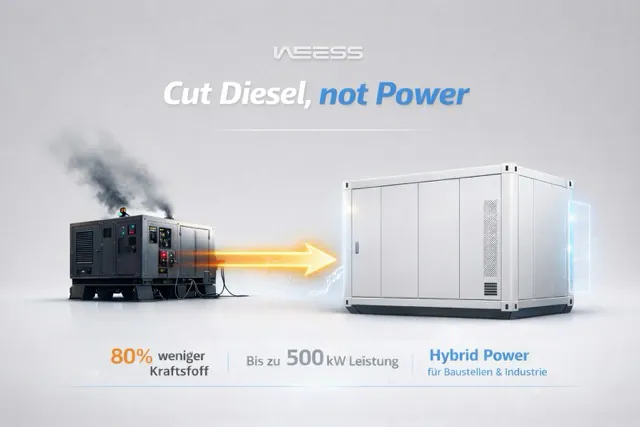
Cut diesel. Not power. Why hybrid energy systems could transform the global generator market
For decades, diesel generators have been an indispensable part of the energy supply for construction projects, industrial facilities and off-grid locations. Whether for large construction sites, mining, infrastructure projects or temporary industrial facilities — mobile power generation worldwide relies predominantly on fossil fuels.
However, this model is coming under increasing pressure.
Rising energy prices, stricter ESG requirements and geopolitical uncertainties are changing the economic landscape. At the same time, a new technological category is emerging that has the potential to fundamentally transform the market: hybrid energy systems comprising battery storage and a generator.
The reality of generator operation: inefficient and costly
In practice, many generators are significantly oversized. They are designed to cope with rare peak loads — such as those caused by cranes or heavy machinery. In everyday use, however, they often run at low capacity.
Industry analyses show:
-Average generator utilisation often below 40%
-High wear and tear due to inefficient operation
-Unnecessarily high diesel consumption
-Increased maintenance and operating costs
This structural inefficiency results in enormous costs and CO₂ emissions worldwide.
Hybridisation: Battery storage as the missing link
The combination of a generator and battery storage fundamentally changes the system architecture.
A storage facility takes over:
-Peak load management
Short-term performance requirements
-Base load supply at low load
-Optimisation of generator running times
The generator now only runs within its optimal operating range to charge the storage system, rather than operating inefficiently in partial-load mode all the time.
The result:
-Significantly lower diesel consumption
-Fewer operating hours
-Lower maintenance costs
-A more stable power supply
Market validation: External projects demonstrate the potential
Several international projects have already demonstrated that hybrid systems are economically viable — regardless of WEESS.
Case Study 1 — Construction site operations with a tower crane
A project in the rental sector combined two battery storage units with a smaller generator instead of the large generators originally used.
Results:
-Diesel consumption reduced from 37,440 litres to 16,380 litres per month
-Savings of around 56%
-Total costs reduced by around 30%
These performance figures are almost equivalent to the capacity of a modern compact hybrid storage system in the region of around 500 kW.
Case Study 2 — Off-grid industrial facility
In another project, a small generator was combined with a battery storage system to ensure a continuous power supply.
Results:
-Diesel consumption reduced from around 80 litres per day to 22–25 litres
-Generator runtime less than 12% of the original operating time
These examples show that hybrid solutions are not only viable in theory, but are already proving economically viable in practice.
WEESS PowerSite Cube: Hybrid Energy System for Construction and Industry
With the WEESS PowerSite Cube WEESS targets precisely this market segment.
The system combines:
-Battery storage (approx. 353 kWh)
-High power output (up to 500 kW AC)
-LFP cell technology
-Scalable container architecture
-Integration with generators or grid connections
The aim is not to replace generators, but to operate them more intelligently — with significantly lower diesel consumption and optimised system efficiency.
The approach is guided by a clear vision:
From simple diesel generators to smart energy systems.
Cost-effectiveness: Rapid payback as a key driver
The cost-effectiveness of hybrid systems depends primarily on diesel consumption.
Typical effects:
40–60% reduction in fuel consumption
-Significantly lower maintenance costs
-Smaller generator size possible
-Greater operational efficiency
In many international scenarios, a hybrid energy system can pay for itself within a few months, particularly in regions with high fuel costs.
This creates an exceptionally attractive investment profile — even without subsidy schemes.
Geopolitical developments are reinforcing the trend
Global developments in the energy sector are providing the market with additional momentum.
Fluctuating commodity prices, supply chain risks and geopolitical tensions are causing uncertainty in the fossil fuel sector. Companies are therefore increasingly seeking solutions to reduce their dependence on diesel.
Hybrid energy systems offer immediate economic benefits here — without completely replacing the existing infrastructure.
A global market worth billions is emerging
The market for mobile power supply is enormous worldwide. The construction industry, mining, infrastructure projects, events and industrial facilities use millions of generators.
The hybridisation of this existing market opens up enormous potential:
-Reduction in operating costs
-CO₂ savings
-Greater energy efficiency
-Integration of renewable energy
-A more stable energy supply
Companies such as WEESS are thus positioning themselves not only as storage manufacturers, but as providers of a new category of energy systems.
Outlook: From generator to smart energy platform
In the long term, the market could develop in a similar way to other industries: moving away from stand-alone devices towards integrated system solutions.
Hybrid energy platforms offer the following potential:
-Integration of photovoltaic systems
-Use of weak grid connections
-Autonomous energy systems
-Digital energy management
This makes energy supply increasingly predictable, efficient and sustainable.
Conclusion: A quiet transformation of mobile energy supply
The combination of battery storage and a generator has the potential to transform one of the largest energy markets, which has hitherto been dominated by fossil fuels.
Systems such as the WEESS PowerSite Cube demonstrate that this transition is not only technologically feasible, but also economically viable.
For the construction industry, industrial companies and infrastructure projects, the question is no longer whether hybrid solutions are on the way — but how quickly they will become the new standard.
Cut diesel. Not power.