

Rethinking tenant electricity: scalable system solutions for apartment blocks
Tenant electricity is regarded as a key component of the energy transition – but has long been associated with a high degree of regulatory and technical complexity. New hardware-based system solutions such as the WEESS PowerTower are changing this: behind-the-meter approaches enable local solar power usage in apartment blocks without traditional supply models. The result is economically viable projects with returns of 8–12% – and a market on the cusp of its growth phase.
.webp?2026-03-18T12%3A52%3A36.607Z)
Rethinking tenant electricity: How new system solutions can transform energy supply for apartment blocks
The expansion of renewable energy in the building sector is regarded as one of the key components of the energy transition. Whilst photovoltaics has grown significantly in the single-family home segment, one area has so far fallen well short of its potential: multi-family homes and neighbourhoods.
More than half of the population in Germany lives in rented accommodation. This makes tenant-generated electricity one of the most effective ways of integrating renewable energy into urban areas. Nevertheless, the implementation of many projects has remained limited for years — despite political support schemes and new regulatory models.
The causes lie less in the lack of interest among market participants than in structural barriers to implementation to date.
Why tenant-generated electricity was long considered complex
Traditional tenant electricity models often involved considerable effort. In particular, full-service provider models under Section 42a of the Energy Industry Act (EnWG) entail extensive requirements:
-Energy supplier role with regulatory responsibilities
-Market communication and settlement processes
-Complex measurement concepts
-High installation costs within the building
-Ongoing software and operating costs
For many housing companies and project developers, this led to financial risks and lengthy project timelines.
Although newer models such as shared building energy supply (Section 42b of the Energy Industry Act) simplify regulatory requirements, they do not automatically resolve the technical and economic challenges of implementation.
In practice, therefore, a clear trend is emerging: tenant-generated electricity must become simpler — technically, economically and in terms of regulation.
A new approach: local electricity consumption without complex supplier models
There is a growing focus on concepts that utilise locally generated electricity within a building without completely replacing traditional energy supply structures.
Technically speaking, this involves what are known as Behind-the-meter solutions, where solar power is distributed directly within the building, whilst mains electricity continues to be sourced from the existing supplier.
In many cases, such systems can even be used purely as Surplus solutions be implemented. This eliminates much of the complexity associated with the energy sector, particularly market communication and supplier obligations.
This creates, for the first time, a model for the housing sector that is economically predictable and operationally manageable.
Hardware-based power distribution as the key to scaling
A key factor in this development is the increasing integration of power distribution, metering and storage into physical system solutions.
By physically separating locally generated solar power (‘green’) and grid power (‘grey’), energy within a building can be clearly allocated. MID-compliant metering systems record only the local electricity that is actually used.
This architecture offers several advantages:
-High regulatory certainty
-No mixing of electricity volumes
-Reduced or discontinued market communication
-Lower operating costs
-Simplified project structure
As a result, tenant electricity is increasingly shifting from a complex supplier model to a technically integrated building energy solution.
The WEESS PowerTower: Tenant electricity system with a focus on simplicity and scalability
With the WEESS PowerTower A system solution has been developed that is precisely tailored to these requirements.
The system combines hardware-based power distribution, MID-compliant metering and storage integration within a modular architecture.
Key features:
Distribution of locally generated energy within the building without mixing it with mains electricity
Implementation of tenant electricity projects also possible as a surplus model
Reduced or no market communication due to a behind-the-meter approach
No ongoing software licence costs
Installation without major modifications to the meter cabinet
Scalability through modular expansion
A PowerTower supplies multiple residential units and can be expanded to cover larger buildings and neighbourhoods by connecting multiple units in series. In combination with the WEESS “Zugspitze” storage system, this creates local energy systems with a high self-consumption rate and stable output per residential unit.
Installation costs as an underestimated cost factor
Until now, a major obstacle to many tenant electricity projects has been the structural work required within the building.
Hardware-based systems often allow integration via supply and return lines without the need for extensive modifications to the existing meter cabinet. This significantly reduces costs, project time and technical risks, particularly in existing installations.
Cost-effectiveness: Tenant electricity as an infrastructure investment
As complexity decreases, cost-effectiveness increases. Depending on building size, consumption and the proportion of self-consumption, market observations suggest that typical project returns are in the range of approximately 8% to 12%, and even beyond that in optimised scenarios.
Key economic factors are:
-High self-consumption rate through the integration of storage systems
-Low ongoing operating costs
-Scalable architecture
-Long-term revenue models
As a result, tenant electricity is increasingly becoming an attractive infrastructure investment for housing companies, project developers and investors.
Grid connectivity as an added benefit
In addition to economic considerations, the system-wide impact is also becoming increasingly important. Local electricity consumption within buildings can:
- Reduce grid loads
-Mitigating peak demand
-Increase self-consumption
-Promoting decentralised energy integration
Particularly in urban areas with limited grid capacity, tenant-generated electricity can therefore make a significant contribution to the energy transition.
A market on the verge of a growth phase
Several developments suggest that tenant-generated electricity could gain significant momentum in the coming years:
1. Technical simplification through integrated system solutions
2. Rising energy prices and pressure to decarbonise
3. Policy focus on the building sector
4. More economically attractive models
This is creating a growing market with long-term potential for the sector.
Conclusion: From complexity to scalable building energy
The energy transition in existing buildings will depend largely on how easily and cost-effectively local energy can be utilised.
System solutions such as WEESS PowerTower demonstrate that tenant electricity can increasingly evolve from a complex specialist model into a scalable standard solution.
For project developers, housing companies and energy suppliers, the question is therefore not so much whether tenant-generated electricity will grow — but how quickly.
Further articles
Industry under power: Energy storage as a new corporate infrastructure
Rising electricity prices, volatile markets and pressure to decarbonise are making energy a strategic resource for businesses. Modern C&I battery storage systems; such as WEESS Bodensee (232 kWh) and Nordsee (4.47 MWh) enable peak shaving, load shifting and higher self-consumption rates – economically predictable and modularly scalable. Energy storage is thus evolving from a cost-saving measure to a strategic asset in industrial transformation.
From battery storage to revenue generator: grid-friendly storage in the energy system
Energy storage is evolving from a purely trading instrument into systemically important infrastructure. Those who rely solely on arbitrage risk fluctuating returns – stable revenues are generated through a combination of balancing energy, flexibility markets and load optimisation. Large-scale storage facilities such as WEESS Nordsee enable precisely this: multi-dimensional revenue models, revenue-share structures and integration into virtual power plants – energy storage as an investable asset with predictable cash flows.
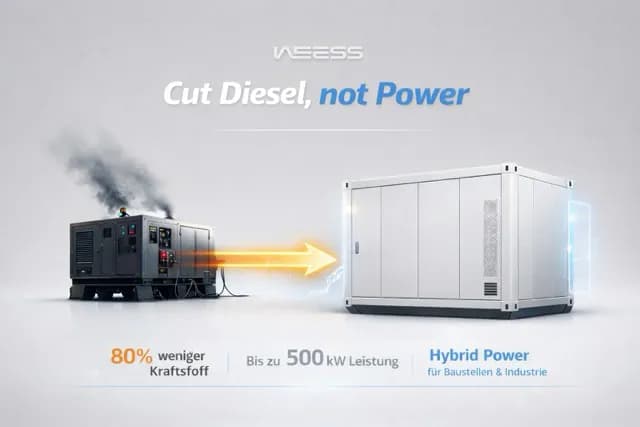
Cut diesel. Not power. Hybrid energy systems as the new standard for construction and industry
Diesel generators operate inefficiently worldwide – often at less than 40% capacity, with high wear and tear and unnecessary costs. Hybrid energy systems comprising battery storage and a generator solve this problem: the storage system handles peak loads, whilst the generator operates only within its optimal efficiency range. Real-world projects demonstrate diesel savings of up to 56%. The WEESS PowerSite Cube targets this global multi-billion-euro market – with a fast payback period, without replacing existing infrastructure.